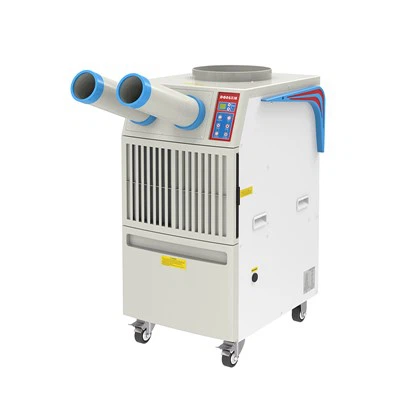
Wuxi Dongxia Machinery Co., Ltd. is one of the most professional manufacturers and suppliers of outdoor heat pump in China. Please feel free to buy OEM outdoor heat pump at competitive price from our factory. For custom service, contact us now.
Company Profile
As the predecessor of Dongxia, Taihu Cooling and Heating Equipment Co., Ltd. was established in the 1990s. At first, the company produced "Dongxia" brand air conditioners. Later, present-day Wuxi Dongxia Machinery Co., Ltd. ("Dongxia") was established as a joint venture between Taihu Cooling and Heating Equipment Co., Ltd. and Nakatomi, Japan.
In the past 20 years since the establishment of "Dongxia" brand, Dongxia has been focusing on air conditioning and processing industry. Now, the main products of Dongxia include: portable industrial air conditioner, industrial dehumidifier, mobile electric heater, fuel-fired heater, etc. Dongxia operates such brands as "Dongxia", "Winter-Summer" and "Nakatomi", providing aid for the cooling of summer employees, products, precision equipment, outdoor operation and other industrial environments.
Why choose us?
Broad market
Our company's products are sold to dozens of countries and regions such as Japan, the United States, Australia, New Zealand, Thailand, Vietnam, Russia, Hong Kong, and Taiwan. With professional and excellent product performance and reliable quality assurance, our company has effectively cooperated with many Fortune 500 companies and has been designated as an exclusive purchasing brand by them.
Professional team
We have a technical team with more than 15 years of product development experience. Our team has always insisted on absorbing the latest technology, and we have committed to improving product performance and extending product service life.
Advanced equipment
We have professional equipment and working environments such as automatic assembly lines, automatic painting lines, and air conditioner performance testing laboratories.
Professional certification
Our products have obtained more than ten national patents and passed a series of certifications such as American ETL, Japanese PSE, European Union CE, and Chinese CCC.
24h online service
We provide 24-hour online service, if you have any questions you can contact us at any time.
Competitive price
Our products are available at factory-direct prices and are of high quality and affordable price.
Related Product

Portable Heat Pump And Cooling Unit
The portable heat pump and cooling unit Model SAC-35HC delivers 11500Btu/h of cooling(or 10300Btu/h of heating) relief with footprint under 6 sq. ft.

Portable Heat Pump Air Conditioner
The Portable heat pump air conditioners are versatile appliances that can be used in various settings.

The Portable heat pump air conditioners are versatile appliances that can be used in various settings.

If you need a portable heat pump AC Manufacturer & Long-Term Oversea Partner,Please contact Dongxia for further questions.

The outdoor heat pump and cooling unit Model SAC-35HC delivers 11500Btu/h of cooling(or 10300Btu/h of heating) relief with footprint under 6 sq. ft.
What is Outdoor Heat Pump
A heat pump is part of a home heating and cooling system and is installed outside your home. Like an air conditioner such as central air, it can cool your home, but it's also capable of providing heat. In cooler months, a heat pump pulls heat from the cold outdoor air and transfers it indoors, and in warmer months, it pulls heat out of indoor air to cool your home. They are powered by electricity and transfer heat using refrigerant to provide comfort all year round. Because they are able to both heat and cool a residence, homeowners may not need to install separate systems to heat their homes. In colder climates, an electric heat strip can be added to the indoor fan coil for additional capabilities. Heat pumps do not burn fossil fuels like furnaces do, making them more environmentally friendly.
Benefits of Outdoor Heat Pump
Heat pumps can be used for heating
The most obvious benefit of a heat pump system is its ability to provide warmth. Heat pumps can very quickly increase the temperature of a room. This can be achieved with the simple touch of a button: at the wall; or on the remote; and even from the comfort of your chair. Even when you are away from home, you can monitor and adjust your heat pumps accordingly using a mobile app.
Heat pumps can be used for cooling i.e. Air conditioning
The "reverse cycle" in the full name of a heat pump refers to its ability to work backwards. In addition to extracting heat energy from outside and bringing this in to your home, your heat pump also has the ability to extract heat from inside your home and transfer this outside (in exactly the same way as a fridge works). The term "Air Conditioning" is more commonly used for the cooling cycle or function of your heat pump.
Heat pumps provide comfort and convenience
Your comfort is the single most important feature of a heat pump, and you are in control. Although most of us are comfortable living within a small bandwidth of temperature all year round (68-73 degrees F whether heating or cooling) we all have our own definition of warm enough or cool enough. A heat pump provides you with the ability to easily control and maintain your climate to your comfort levels.
Heat pumps are safe
Unlike gas heating or wood burners, there are no flames or hot surfaces that children or pets can touch and burn themselves on. They can also be safely left on while you're out or asleep.
Heat pumps improve air quality
Heat pumps don't create smoke or add any fumes to the air. Also, as your Heat Pump circulates the air in your room, the unit filters clean and purify the air removing dust, mold spores, odors, smoke and other particles. They are excellent for people who suffer from asthma and allergies.
Heat pumps save space
As heat pumps become more popular, they are adding value to your home. A warm, dry, comfortable environment with the addition of air conditioning will always be first choice over a house without such sought after benefits. Heat pump design and aesthetics are becoming streamlined and less obstructive, you barely see them.
Heat pumps are very energy efficient
Heat Pumps are currently one of the most cost-effective form of heating using electricity and most good quality systems achieve average COP (Coefficient of Performance) figures of four or more. This means that to achieve four kilowatts of heating or cooling power, they use an average of less than one kilowatt of electricity. A conventional heating system such as an electric fire or gas boiler has a COP of less than one. This means that it burns more than one kilowatt of power to produce a kilowatt of heating power. The higher the COP the cheaper a heating appliance is to run. In comparison to other forms of heating, Heat Pumps offer the most energy efficient heating with between 300% to 400% efficiency.
Heat pumps are"eco-friendly"
The combustion process of wood burners causes fumes, soot and smoke which provide a major burden on the environment in terms of its carbon emissions. Utilizing heat pumps reduces fossil fuel consumption. As the Heat Pump does not burn anything at the heat energy source, there are no additional carbon emissions other than the small amount of electrical energy required to run the compressor.
Heat pumps dehumidify
During summer, when you are using your heat pump for cooling, the room is automatically dehumidified as a function of the Heat Pump. During winter the heat pump prevents condensation forming on cold surfaces such as windows by circulating warm air around the room similar to demisting a car windscreen on a cold morning.
Types of Outdoor Heat Pump
Air source heat pumps
Air source heat pumps are heating systems that utilize the external atmosphere to generate warmth for an abode or structure. The exhaust air heat pump transfers warmth from the exterior to within, working for cooling and heating.
Ground source heat pumps
Ground Source Heat Pumps (GSHPs) are a form of renewable energy technology that uses the heat stored in the ground to provide heating and cooling for buildings. GSHPs are becoming increasingly popular due to their efficiency, low running costs, and environmental benefits.
Hybrid heat pump systems
Hybrid heat pump systems are a type of heating system that combines an air-source heat pump with an electric resistance heater. The hybrid system uses the air source component when temperatures are above freezing while switching to the electric resistance heater when temperatures drop below freezing.
Ductless mini-split heat pumps
Ductless mini-split heat pumps use an outdoor unit connected to one or more indoor units via refrigerant lines. This allows for efficient heating without requiring ductwork installation and provides individual temperature control in different rooms or areas within the same space.
Geothermal heat pumps (GHP)s
Geothermal heat pumps (GHP)s are renewable energy technology that uses the natural heat stored in the ground to provide heating and cooling for buildings. GHPs use an underground loop system filled with water or antifreeze solution, which absorbs heat from the environment during winter and releases it back into the Earth during summer.
Water source heat pumps
WSHPs use the natural water temperature from an underground aquifer, lake, river, or ocean to transfer heat into buildings for space heating and hot water needs.
How Outdoor Heat Pumps Work
Heat pumps are a special type of air conditioner. Just like the regular type, heat pumps keep things cool when it's hot outside by removing unwanted heat from your home and "pumping" it outdoors.
Unlike regular ACs, however, heat pumps can work their magic not just to provide cooling when it's hot out but also to provide heating when it's cold out. It's the same process, just reversed: Heat pumps can pick up heat from outside (even when it's cold) and pump it into your house to keep it warm.
This magic happens by way of refrigerant gases that are expanded and compressed inside the heat pump system. Refrigerant gases are found in conventional ACs, too, and have their own environmental impact, so experts are working to replace them with climate-friendlier ones. But even considering these impacts, heat pumps have a significantly lower climate impact than traditional equipment. And models with lower "global warming potential" refrigerants will soon be hitting shelves.
Outdoor Heat Pump Installation Notes
There's a lot of flexibility as to where outdoor units can be installed. Here are some considerations:
Aesthetics: Outdoor units are most commonly mounted on or next to homes. Because outdoor units can be mounted over fifty feet from their indoor units, they can be installed on an inconspicuous side of the house, under decks, or even far-removed from the home.
Unobstructed airflow: Although it's tempting to tuck units into tight places for aesthetic reasons, it's important to remember that they extract heat from the outdoor air. The more airflow they get, the better they'll work. Avoid shrubs, places prone to snow drifts, and structures that might block airflow. It's also important to make sure outdoor units aren't blowing onto one another.
Door, window, and walkway interference: It's best to avoid installing the outdoor unit where it could interfere with the operation of a door or window. In addition, outdoor units release water when they defrost in the winter, which can form icy patches if installed near a walkway. Be sure to pick a spot where that won't be an issue.
Roof runoff: If the outdoor unit is going to be installed under a roof drip line, then be sure the unit is equipped with a rain cap to minimize the risk of it icing up.
Serviceability: Keep in mind ease of service when selecting an installation location.
Components of Outdoor Heat Pump
The evaporator coil
The evaporator coil is responsible for absorbing heat into the refrigerant as it evaporates from a liquid to a gas. It acts as the heat collection point, gathering thermal energy to be moved elsewhere by the system. In heating mode, the evaporator coil is located outdoors; in cooling mode, it is located indoors.
The compressor
The compressor is the "pump" in a heat pump system. It pressurizes the refrigerant gas after it leaves the evaporator coil, increasing its temperature. This prepares the refrigerant to release heat energy when it reaches the condenser coil. The compressor is powered by an electric motor and is the primary energy user in the system.
The condenser coil
While the evaporator coil collects heat energy, the condenser coil releases it. As the hot, pressurized refrigerant passes through the condenser coil, it condenses back into a liquid state, dissipating heat in the process. In heating mode, the indoor condenser coil distributes heat into the home; in cooling mode, the outdoor condenser releases heat to the exterior environment.
The expansion valve
The expansion valve is responsible for reducing the pressure of the liquid refrigerant after it leaves the condenser coil. By regulating refrigerant flow back to the evaporator, it allows the refrigerant to evaporate and begin absorbing heat energy once again. This repeating cycle is what drives the heat transfer process.
How to Maintain Outdoor Heat Pump
Clean the dust from the filters
As a rule of thumb, you should be cleaning your Heat Pump's filters every season (every 3 to 4 months). Over time the build-up of dust and debris can clog the air filters and restrict air flow. Cleaning your filters regularly will ensure that your Heat Pump operates at optimum efficiency and reduces unnecessary energy consumption.
Clean the indoor unit grilles
Dust also accumulates on the grilles of your indoor unit. Gently vacuum along the grooves or gently wipe with a damp cloth for efficient air flow.
Clean the outdoor unit
Did you know that cleaning the outdoor unit of your Heat Pump Air Conditioning System is just as important as cleaning the air filters of your indoor unit?
To keep your unit running at its best make sure to keep the outdoor unit clear of organic matter such as leaves, weeds and debris.
Then isolate the outdoor unit from electrical supply before cleaning down the outdoor unit (even if you have turned off the indoor unit). You will find this switch next to the outdoor unit.
Wash the unit down using very low pressured water from a garden hose.
Get your heat pump professionally serviced every 12 months
The tips above will help keep your unit working effectively and efficiently. But they don't replace the need to have your system professionally serviced by an accredited Heat Pump Air Conditioning technician.
A professional service will ensure your system will run smoothly and efficiently, delivering comfort to your home while extending the life of your investment.
Certifications

Our Factory
The production and operation headquarters of Dongxia in China are located in Wuxi, Jiangsu Province, within 2 hours of driving from Shanghai. It has a 30000 ㎡ modern plant warehouse, full-automatic assembly lines and testing equipment, and a huge technical R&D team, with an annual production capacity of 200,000 air-conditioners. It has obtained more than ten national patents and has passed a series of certifications such as ETL of the United States, PSE of Japan, CE of the European Union and CCC of China.


FAQ
Hot Tags: outdoor heat pump, China outdoor heat pump manufacturers, suppliers, factory, heat pump spot cooler for stadium, heat pump spot cooler for workshop, Portable Heat Pump Unit, heat pump spot cooler for house, heat pump spot cooler for indoor event, heat pump spot cooler for apartment